CFB Wainwright Fire Started on a Live-Grenade Range, Military Says — and Firefighters Couldn’t Go In
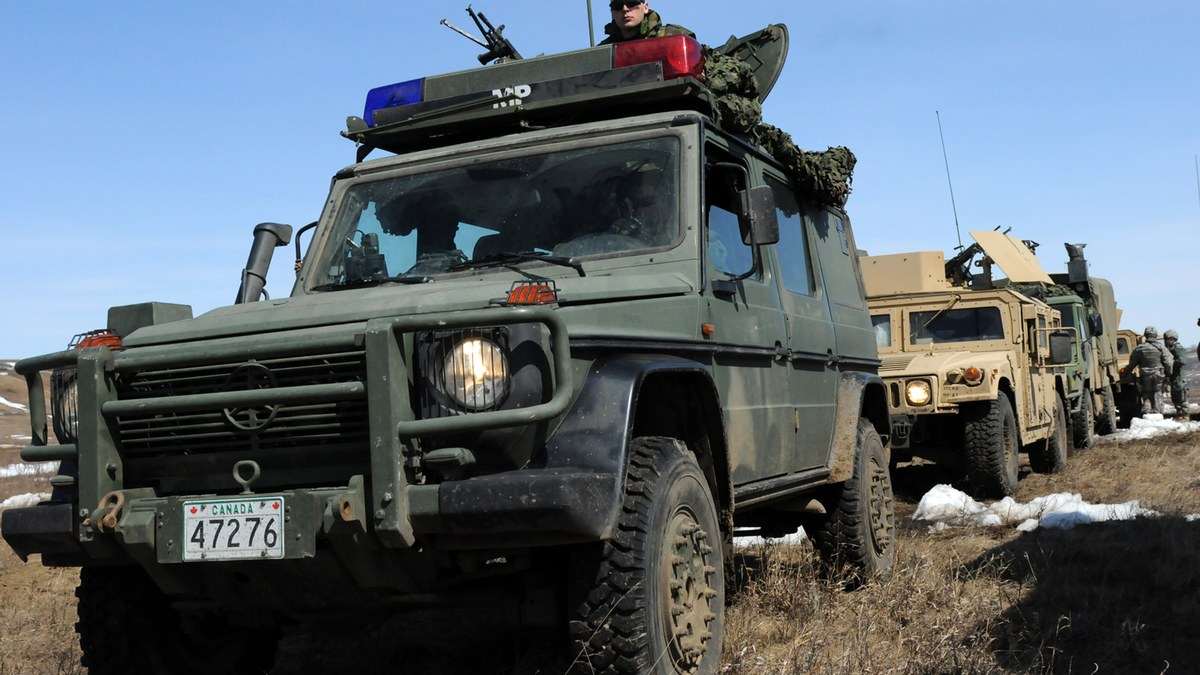
File photo: Military vehicles at Canadian Forces Base Wainwright during an exercise (Spc. Hector Corea / U.S. Army / Wikimedia Commons, public domain).
Five days after the worst peacetime tragedy in the Canadian military's recent history, the army has finally said what happened at CFB Wainwright: the fire that killed four soldiers started on the base's automatic grenade launcher range, during a training exercise involving live grenades — and because the fire began in a zone firefighters weren't allowed to enter, it was allowed to smoulder for hours before the wind turned it into a killer.
Brigadier-General Vanessa Hanrahan, the Canadian Forces Provost Marshal — the military's top police officer — delivered the update at a Thursday news conference, according to Reuters. "The fire initiated on the automatic grenade launcher range ... (it) initiated as a result of routine military training that was happening on that range at the time," Hanrahan said.
Why firefighters couldn't fight it
This is the detail that will haunt the investigation. The blaze began inside what the military calls "Permanent Danger Area 2" — part of the range that may be contaminated with unexploded munitions. Range standing orders kept firefighters from attacking the fire directly, so, in Hanrahan's account, "it was therefore monitored throughout the day by both range control and the base firehall."
Then came the weather. Environment Canada has confirmed a fast-moving cold front hit Alberta on Saturday with wind speeds of 90 to 130 km/h. A wind warning went out for Wainwright at 2:14 p.m. local time; about an hour later, gusts of up to 105 km/h drove the fire out of the danger area and straight at the soldiers' positions. Prime Minister Mark Carney said Monday the fire jumped nearly a kilometre in less than a minute.
Enjoyed this guide?
Canada Pulse is an independent publication. Every guide is researched, written and carefully edited, and kept free forever. If this saved you time or made your life easier, please don't let the effort go unnoticed — support our work with whatever you can, from $1 upward. Every dollar keeps the guides coming.
💛 Donate via PayPalThe soldiers who died
The four soldiers killed on Saturday have been named: Sergeant Morgan Wong of Edmonton, a reservist with the Loyal Edmonton Regiment; Private Shaun Farrell of Prince Albert, Saskatchewan; Private Aidan Goulding of North Vancouver, B.C.; and Private Hayden Lykkemark of Langley, B.C. Farrell, Goulding and Lykkemark served with the 3rd Battalion, Princess Patricia's Canadian Light Infantry; Wong was training with the battalion.
About 84 soldiers from Charlie Company, 3rd Battalion PPCLI, were training when the fire overran them — part of a larger group preparing to deploy to Latvia, where Canada maintains its largest international military operation. The army says 27 soldiers remain hospitalized and 12 have been released, with several of those in hospital still in critical condition.
Three investigations, one promise
There are now three separate investigations running at once: a military board of inquiry, the Canadian Forces National Investigation Service (the military police, which Hanrahan leads), and the Alberta chief medical examiner's office. Hanrahan emphasized there is no evidence pointing to a criminal cause, and no natural gas infrastructure was involved. She cautioned that investigators have not pinned down the precise ignition mechanism yet — the work of understanding exactly when, how and why the fire escaped is still ahead of them.
Major-General Wade Rutland, commander of the 1st Canadian Division, told reporters in Edmonton on Thursday that the investigation will take longer than the roughly one month he had first suggested — and he promised the military was dedicated to an "honest account" of the details leading up to the fire. That's the right promise, and it's one families and the country should hold him to.
The question nobody has answered
Because here's the question nobody has answered yet: who decided that live-grenade training was safe in dry conditions on a Saturday, when a cold front with 100 km/h winds was forecast? Monitored or not, the fire started on a military range and ended with four young Canadians dead and dozens in hospital. The investigation will tell us how. The harder question is whether it should have been allowed to start at all.
Sources
- Reuters, "Deadly fire at Canada military base was caused by live grenade exercise, army says" (Oct 22, 2026) — reuters.com
- The Canadian Press (via YYC24), "Military says CFB Wainwright fire began during live-grenade training; 27 remain hospitalized" (Oct 22, 2026) — yyc24.ca (Canadian Press report)
- CBC News: Hanomansing Tonight, "CFB Wainwright fire triggered by exercise on grenade-launcher range: officials" (video, Oct 22, 2026) — youtube.com
- The Canadian Press (via NewsBeep), "Devastating fire at CFB Wainwright started on automatic grenade launcher range, official says" (Oct 23, 2026) — newsbeep.com (Canadian Press report)
- The Weather Network, "Officials say high winds intensified fire at CFB Wainwright" (Oct 20, 2026) — theweathernetwork.com
Enjoyed this guide?
Canada Pulse is an independent publication. Every guide is researched, written and carefully edited, and kept free forever. If this saved you time or made your life easier, please don't let the effort go unnoticed — support our work with whatever you can, from $1 upward. Every dollar keeps the guides coming.
💛 Donate via PayPal