Mark Carney Says Canada Can Wait for a New US President to Get a Trade Deal
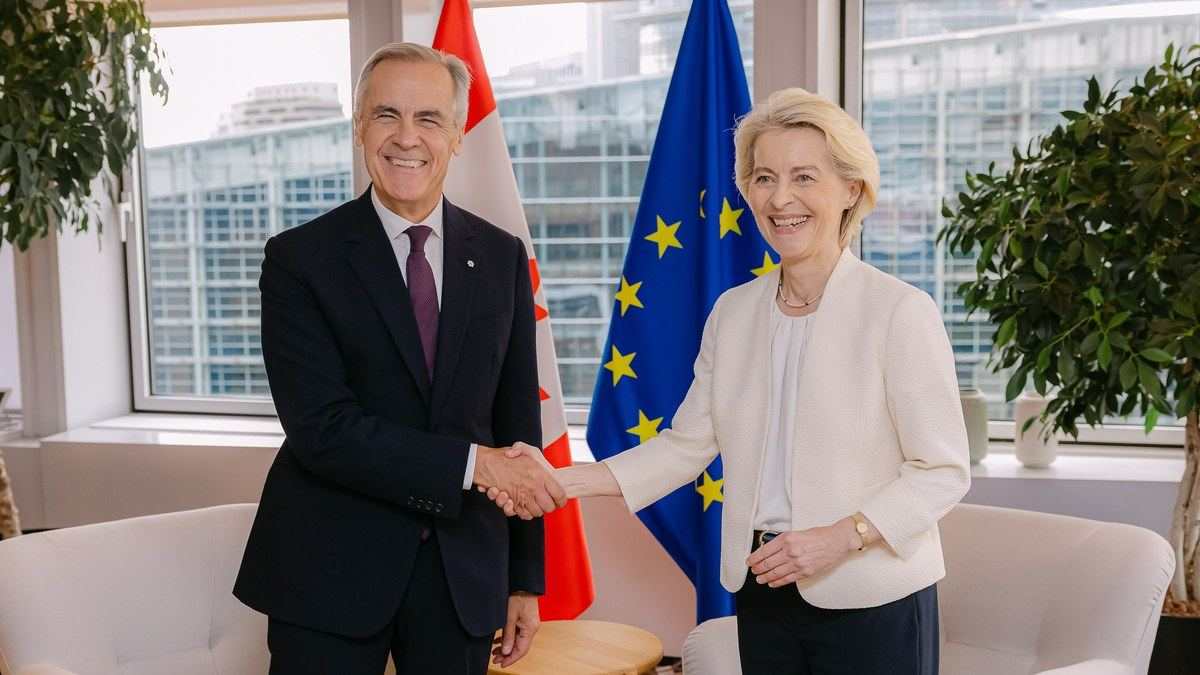
Archive photo: Prime Minister Mark Carney meets European Commission President Ursula von der Leyen in September 2026. Photo: European Commission Audiovisual Service / Christophe Licoppe, CC BY 4.0, via Wikimedia Commons.
It was the sentence that travelled furthest from Montreal, and it was only eight words long. Asked whether he would really wait for the next American president if that is what it takes to get a trade deal worth signing, Mark Carney did not dodge, soften, or reach for diplomatic fog. "We'll have to, if that's what it takes," the prime minister told POLITICO. In a week when every headline out of Washington seemed to promise a deal just around the corner, Carney used his interview to say the opposite: Canada is in no hurry, and a bad deal is worse than no deal at all.
The interview that reset the clock
The conversation happened in Montreal on October 30, just as Carney wrapped up the two-day Canada-EU summit with European Commission President Ursula von der Leyen and European Council President António Costa. The timing mattered: four days before Americans vote in the November 3 midterms, Carney was speaking to two audiences — voters at home feeling the tariffs, and a White House insisting a deal is close.
His message, according to POLITICO, was blunt in a way Canadian prime ministers rarely are about the United States. A deal is possible, he said — it could even be done "this afternoon" — but only if it is genuinely in Canada's interest. "We're not going to conclude something for the sake of concluding it," he said.
That distinction is the whole story: Carney is not walking away from the table, he is saying it is not the only place Canada can sit.
What went wrong in August
To understand why Carney sounds so unbothered about waiting, go back to August 21, when Canada suspended formal trade negotiations. According to reporting on the breakdown, Ottawa concluded that Washington's last-minute demands threatened Canadian economic interests and independent policy decisions, including protections for culture and the French language. American officials dispute that account. Either way, the talks broke down and have not properly restarted.
What followed hit the industries Canada can least afford to lose. The United States maintains tariffs of up to 50 per cent on Canadian steel and 25 per cent on automobiles, according to the Philippine Canadian Inquirer. For factory towns in Ontario, where auto plants and steel mills anchor whole communities, that is not an abstraction — it is shifts cut and orders delayed.
Ottawa has tried to cushion the blow: on October 21, Carney and Ontario Premier Doug Ford announced C$8.7 billion in support measures for affected businesses, including steel producers and automakers. Real help, but nobody in Queen's Park or Ottawa pretends it replaces a trade deal.
Why waiting is a strategy, not a shrug
Here is where Carney's argument gets interesting, and where his critics say it gets risky. He framed patience as leverage. "Every month that goes by, Canada grows stronger, our options increase," he said. The longer Canada holds out, the more partnerships it builds elsewhere — the Montreal EU deal-making being exhibit A — and the less it must accept whatever Washington offers.
Enjoyed this guide?
Canada Pulse is an independent publication. Every guide is researched, written and carefully edited, and kept free forever. If this saved you time or made your life easier, please don't let the effort go unnoticed — support our work with whatever you can, from $1 upward. Every dollar keeps the guides coming.
💛 Donate via PayPalThere is also a political read on the American side. Carney told POLITICO that American families and businesses "will also lose out" if no deal is reached: "they're not winners in this circumstance." Tariffs, in other words, are a tax Americans pay too — and with the midterms days away, that argument lands differently in Washington than it did in the summer.
Carney also pushed back on recent diplomatic noise. According to Newsmax's account, he said Canadians were growing tired of provocations from the United States, and he rejected American accusations of Canadian election meddling. The White House did not immediately respond to POLITICO's request for comment.
What happens now
So what should Canadians actually expect? Not a sudden breakthrough, if Carney is to be believed. Officials keep talking about tariff relief for steel and autos, and Washington has offered limited relief for some farm and forestry products — but according to reporting on the talks, a Canadian official said on October 28 that progress remained limited.
President Donald Trump has suggested the dispute could be resolved soon, though neither government has announced a timetable. That gap between Trump's optimism and Carney's patience is the space this standoff now lives in.
For workers in Oshawa, Hamilton, and Windsor, the honest truth is that neither man's words pay a bill. Carney is betting that a short period of pain now buys a better deal later — one that does not trade away what Canada has said it will not trade. Whether that bet pays off depends on something no prime minister controls: how long American voters and businesses are willing to pay for the same standoff. The midterms will give the first hint. The full answer may take much longer.
Sources
POLITICO — Carney interview, published October 30, 2026 (as reported by Bloomberg Law, Business Insider, Newsmax and CBC).
Bloomberg Law — "Carney Says No Hurry on Trade Deal If US Won't Offer Good Terms," October 31, 2026.
Philippine Canadian Inquirer — "Carney refuses to rush US trade deal as tariffs continue to hit Canadian industries," November 1, 2026.
Newsmax (via EuropeSays) — "Carney: Canada Can Wait Trump Out for US Trade Deal," October 31, 2026.
Enjoyed this guide?
Canada Pulse is an independent publication. Every guide is researched, written and carefully edited, and kept free forever. If this saved you time or made your life easier, please don't let the effort go unnoticed — support our work with whatever you can, from $1 upward. Every dollar keeps the guides coming.
💛 Donate via PayPal