Canada's $100-Billion Submarine Deal Just Shifted: 8 Boats Now, 4 Later — and $86 Billion Hangs in the Balance
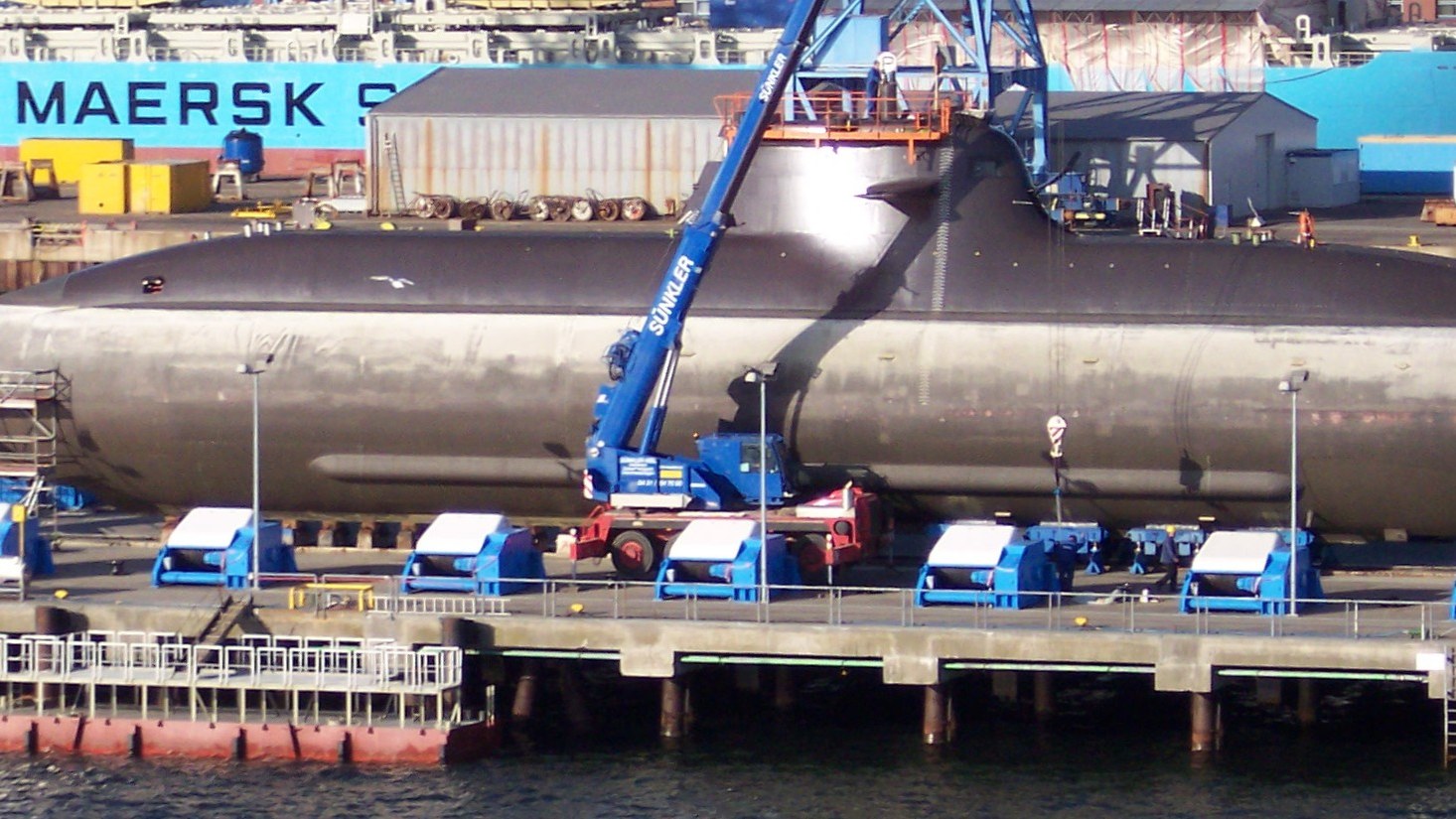
Photo: Stahlkocher / Wikimedia Commons (CC BY-SA 3.0) — File photo: a Type 212 submarine in the docks at HDW, Kiel, Germany, 2005. The Canadian boats would be the newer Type 212CD variant, built jointly by Germany and Norway.
Twelve submarines made the headline in July. Four months later, the number Ottawa is actually prepared to sign for looks smaller — and the gap between the two numbers is worth tens of billions of dollars.
CBC News reported on November 4 that Canadian negotiators have proposed splitting the purchase into two batches: eight submarines ordered firmly now, with four more held as an option for a later decision. The proposal came up in meetings in Ottawa last week between federal officials, led by the Defence Investment Agency, and representatives of German builder ThyssenKrupp Marine Systems (TKMS) and Norwegian defence firm Kongsberg, according to CBC's sources. Nothing has been signed. That matters, because a proposal is not a purchase — but it is the clearest sign yet of how Ottawa is thinking about the biggest defence buy in Canadian history.
Why eight now, four later?
The logic, as CBC's sources describe it, is financial breathing room. Committing to eight boats now instead of twelve keeps the door open for a future government to decide whether the last four are still affordable, still needed, or still the right design. The idea has been on the table since September, after Canadian officials met their counterparts in Europe, and it surfaced again in the Ottawa talks. Officials involved in the discussions maintain that eight is still, in their words, a very large number — and for a navy that currently struggles to keep a single submarine seaworthy, they have a point.
Flexibility has a price, though. Germany has tied an $86-billion economic package to the deal — work spanning critical minerals, port development, carbon capture in Alberta, modernizing the Port of Churchill, and joint work on hypersonic missiles, according to reporting on the negotiations. CBC reports that Berlin is now examining what a smaller firm order means for those pledges, and that TKMS is consulting 400 suppliers about the change. Defence analyst Dave Perry warned that buying in stages gives up economies of scale and weakens Canada's leverage with suppliers — the full economic upside, in his view, may depend on committing to the whole fleet from the start.
Enjoyed this guide?
Canada Pulse is an independent publication. Every guide is researched, written and carefully edited, and kept free forever. If this saved you time or made your life easier, please don't let the effort go unnoticed — support our work with whatever you can, from $1 upward. Every dollar keeps the guides coming.
💛 Donate via PayPalThe boats at the centre of it
The submarines in question are the Type 212CD, a German-Norwegian design already on order for the German and Norwegian navies. Roughly 73 metres long and displacing about 2,750 tonnes on the surface, the boat runs on fuel-cell air-independent propulsion — it can stay submerged far longer than a conventional diesel boat that must snorkel to recharge — and it is built to operate under Arctic ice, which is exactly the job Canada needs done across three oceans.
They would replace four Victoria-class boats Canada bought second-hand from Britain in 1998. Those boats were designed in the 1980s, and their Canadian service has been a long story of dockyard time: usually only one of the four is seaworthy at a time. Prime Minister Mark Carney said it plainly in Halifax on July 6, when he named TKMS the preferred supplier: one working submarine, he said, gives Canada 'insufficient capability to ensure a credible presence on more than one of our three coasts at the same time.'
What the deal is worth — and what is still open
The numbers around this program are so large they stop sounding real. CBC puts the purchase price for the full fleet at $20 billion to $24 billion; the full lifetime cost, with decades of maintenance, weapons, training and infrastructure, runs past $100 billion. Carney said in July the project would 'directly create and sustain an ecosystem of well over 100,000 well-paying jobs.' Hanwha Ocean of South Korea, which offered its KSS-III design, remains the reserve supplier — Ottawa can turn back to Seoul if talks with TKMS break down.
What to watch next
Two dates frame everything now. Ottawa wants a contract concluded by the end of 2027, and the first new boats are expected in the mid-2030s, with Germany and Norway giving up production slots so four Canadian boats can arrive sooner. The second date that matters is closer: Finance Minister François-Philippe Champagne tables Budget 2026 on November 5, a day after this submarine story broke, and the budget will show how much fiscal room Ottawa believes it has for commitments of this size. Watch whether the government confirms the eight-plus-four structure in public, whether Berlin's $86-billion package shrinks with it, and whether Halifax — where much of the submarine work is expected to land — starts hearing firm timelines instead of options. Twelve boats may still happen. But for now, the negotiation has a new shape: eight certain, four conditional, and a lot of money riding on which of those two numbers wins.
Sources
- CBC News, November 4, 2026, reporting on the proposed 8+4 split (via outlets carrying the CBC report) — CBC report summary: eight upfront, four later and TKMS analysis citing CBC: $86-billion package, 400 suppliers, Dave Perry warning. Note: no verbatim CBC article URL was available in search results, so the CBC report is cited through these carriers rather than a guessed link.
- Defense News, “Canada picks Germany’s TKMS for historic submarine buy, in nod to Europe” (July 7, 2026) — Defense News — July 6 selection, Type 212CD, Victoria-class replacement, lifetime cost.
- The War Zone, “Canada Picks German Type 212 Submarine For Badly Needed Fleet Renewal” (July 2026) — The War Zone — 212CD specifications, under-ice capability, Victoria-class condition.
- 19FortyFive, “Forget the F-35 Debate: Canada’s Old Diesel Victoria-Class Submarines Need to Somehow Limp Along Until 2034” (October 7, 2026) — 19FortyFive — Carney’s “one seaworthy boat” quote, 2034 delivery timeline, contract deadline end of 2027.
- Video (text link only — oEmbed-verified as real and on-topic, but the channel is not a major outlet, so no embed used): The War Dockyard, “Why Canada Chose Germany’s Type 212CD Over Korea’s Bigger KSS-III” — YouTube explainer.
Enjoyed this guide?
Canada Pulse is an independent publication. Every guide is researched, written and carefully edited, and kept free forever. If this saved you time or made your life easier, please don't let the effort go unnoticed — support our work with whatever you can, from $1 upward. Every dollar keeps the guides coming.
💛 Donate via PayPal